
Liberalism versus Trumpism and the Alt-Reich Ideology
The “we the people” liberal constitutional interpretation and the oligopoly interpretation “for the accumulation by the wealthy” remain in conflict after the recent battles.
Feb 1, 2021
The economic and political war between Liberalism and Conservatism that began in 1775 is not over. Battle lines have changed, as Georgia showed in 2020 and Washington DC in 2021, with the failed Insurrection and the new Big Lie campaign for 2024.
The centuries of conflict between liberalism and conservatism in the United States is confusing and convoluted. Cognitive science explains how intuition and rational reasoning have been used to justify actions and events more so than accurate reporting.
Add the revisionist history, political propaganda, and the Political Party system created by the second Constitution and it becomes nearly impossible to decipher. The issues have contributed to the current confusion that is now fused by the political party system that came to life with the second constitution .
Whether intended or not, the political opening of China in the 1970s set in motion new economic forces and future government actions that produced a fundamental restructuring of capitalism and communism. The Soviet Union’s transformation into a Republic in 1978 solidified the transformation.
The following self-explanatory charts show the US income and income group impact since the opening of China, the conversion of Russia, and the Reagan voodoo Economic system of tax cuts for the rich.
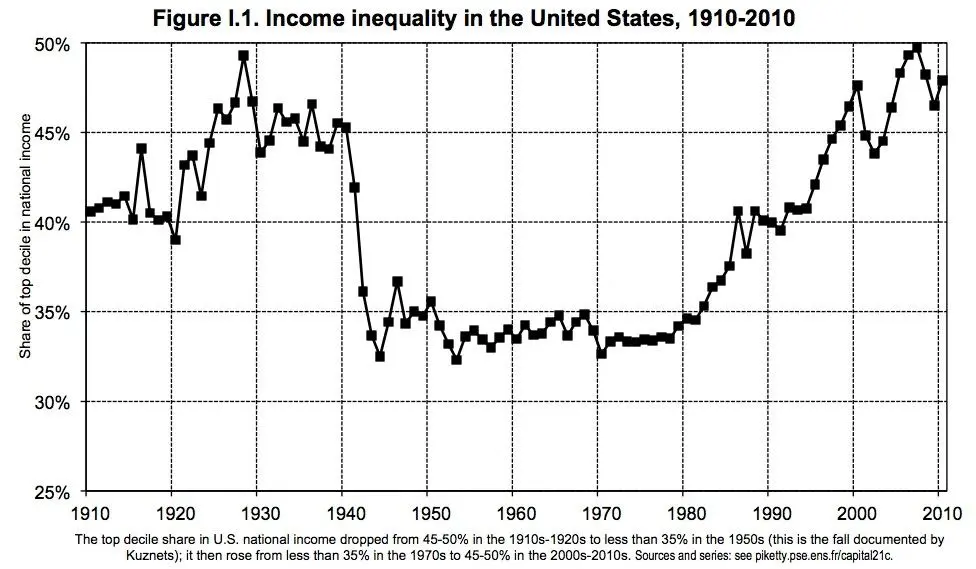
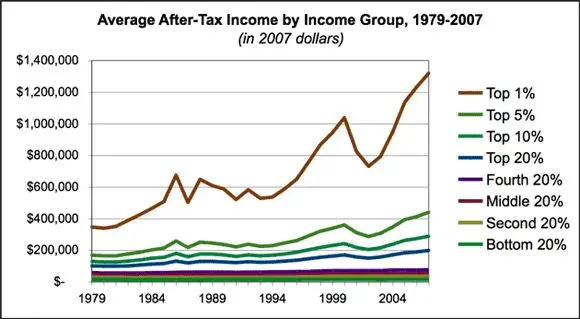
How it worked out for the United States seems to have been a dramatic economic change in the Income Inequality of the people. The Income Inequality was based on which Income Group you were in during the period of transformation and change.
China and Communism went through a similar transformation. In 1980, after the death of Moa (1976) and the disposing of the Gang of Four, the United States was the largest economy in the world, based on GDP. Japan was second, and Germany was third.
Communist China was seventh, and Communist Russia was eleventh in 1980. The Tiananmen Square protests in 1989 signaled that an unknown form of democracy (demo Greek meaning the people) was affecting China. In this way, a political liberalization in Russia (glasnost and perestroika), in 1985, preceded the total collapse of the Soviet Union, in 1991.
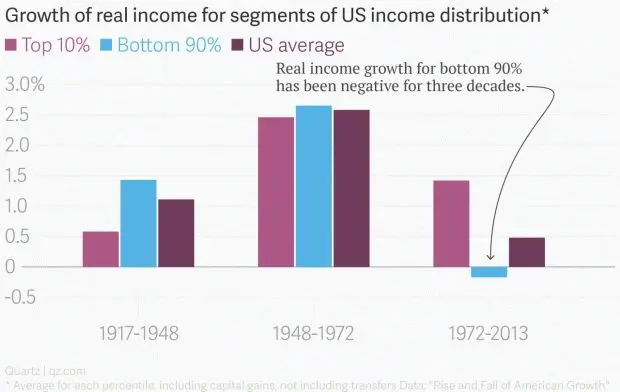
Although we do not have detailed economic information on China and Russia over the century, the numbers we have for the United States show that our economic system has clearly transformed since the opening of China.
Sadly, the US numbers suggest it has transformed us into a quasi-feudal lord like economic model, for the accumulation of wealth by the wealthy, much like China and Russia.
In fact, the various researchers that produced the charts are showing how our government’s actions and the opening of China have economically failed most of the people in our country.
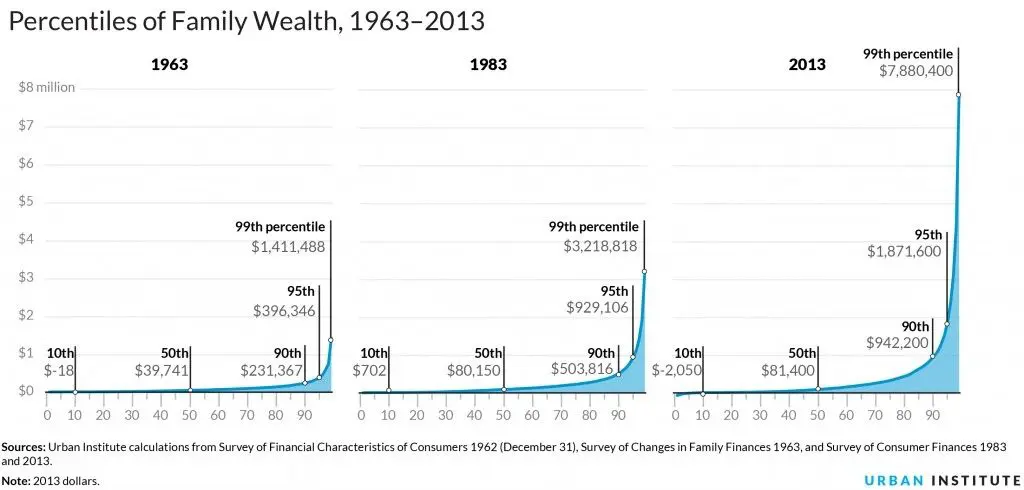
The failure assessment is based on the economic analysis of the Real Incomes by the top 10% of the people versus the other 90% of the people, during the interval since the opening of China, compared to both the post-war era and even the World War 1 and 2 period. Although the economy has been a failure for most of the population it has been highly successful for the accumulation of wealth by the wealthy and the high wealth 90% percentile and above in America, as shown in the following chart.
As Mr. Green pointed out in his question, it was hoped that the opportunity to adopt capitalism and its reliance on the exchange of goods and services between buyers and sellers would transform China over the years. Many economic changes in the world suggest that the opening achieved those goals in China, although it may not have worked out the way we might have liked in the US.
China’s embrace of their form of transaction-based buyer-seller capitalism, for example, has moved them from seventh place to second place, in terms of GDP, early in the 21st Century. They have even earned the nickname of the “manufacturer of the world” in this century.
On the downside, Mr. Trump seems to believe that the new sellers in China also cheated the buyers in the US, by stealing intellectual property through Wall Street-led acquisitions, the “offshoring” of acquired production, and the “outsourcing” of labor via Junk Bonds and Hedge Fund deployments that produced China’s ownership of many America Companies.
History and the left-over footprints in the sands of time suggest that offshoring businesses and outsourcing labor decisions, coupled with the mergers and acquisitions and the looting of business treasuries, produced our 1972 – 2013 income distribution results. Obviously, China was a willing participant in the Wall Street-Shanghai-Hong Kong-Shenzhen process.
As mentioned earlier, China’s transformation probably began with the death of Mao in 1976. His death was followed by the establishment of a civil police and military coalition that pushed out the rest of the “Gang of Four” and replaced them with Deng Xiaoping (an early leader who was “purged” during the first phase of China’s Cultural Revolution, in the 1960s).
Deng ruled China for the next 20 years, as they developed their new Robber Baron feudal lord income class, for the accumulation of wealth by the wealthy, just like we were doing in the US. The new Robber Baron Class in the United States began with a massive tax cut for the rich in 1981. The government followed the tax cut with seven tax increases on the working class, and a doubling of the national debt, during Reagan’s two terms (1981-1988).
The tax and debt fiddling processes in the United States called Reagan’s Voodoo Economics also produced the weakening of national unions and the “deregulation” of Wall Street and Banking, with the authorization of Junk Bonds, in 1984 (high risk, high yield debt instruments not valued by or backed by “corporate” assets or individual wealth). The expansion of Hedge Funds followed in 1987 (loosening of the financial investment funding processes to double the leverage of high-risk junk bonds and derivatives).
The junk bond financing processes enabled the financial community to acquire real corporate assets and ownership, through tax-advantaged stock exchanges, backed by junk bonds, to produce debt-based cash stock buybacks. Together, the two processes enabled the shift in ownership to the new Captains of Industry (AKA Feudal Lords, Robber Barons, financial magnates, financial tycoons, merchant princes…).
The New Captains of industry also used the expanded tax-advantaged forms of Offshoring and Outsourcing versus near-shoring, to produce untaxed offshore profits. This extra level of offshoring and outsourcing also maximized Wall Street fees and the market value of hedge funds, index funds, and various mutual funds.
The new offshoring that began in the 1990s was an expansion of the traditional near-shoring activities that large US corporations practiced. Locating certain types of production facilities in nearby nations, with lower labor costs, cheap power, government incentives, fewer regulations on a cleaner environment, non-unionized environments, and only a short highway/railway-based supply chain route, made Canada and Mexico attractive places for GE, GM, IBM, GTE, Boeing and MERK type production facilities.
NAFTA, in 1993, solidified and formalized these near-shoring processes. Much of the garment, sewing, and textile industry also adopted the practice. Today, NAFTA is an ongoing example of capitalism’s cheating of American processes, at least as far as Donald Trump and the Republican administration viewed it.
Changes in regulations, Free Trade Agreements, and unions losing political power with Washington made true offshoring (moving work and production offshore to improve margins, increase profits, and avoid taxes) ever more attractive to Wall Street commercial banking and the junk bond-based hedge funds.
While the US was capitalizing on NAFTA over the last thirty years, both China and Russia rewrote their constitutions and redid their economic models too. In the period since the rewrites, China has adopted a lot of capitalism’s ideas about buyer and seller transactions. It earned the nickname as the manufacturer of the world, in the 21st Century, as they became the second largest economy in the World. Russia, meanwhile, remained in 11th place, behind Canada, although they invested heavily in the hedge funding, junk bond, and money laundering processes of Wall Street.
It is clear, the Nixon trip helped start and inspire China to become more like us, economically. Alas, the trip also seems to have inspired us to become more like them, in the structuring of Income streams for the accumulation of wealth by the wealthy. Other positive outcomes are not as clear.
China’s government actions and legislation to stimulate their economy and improve their wages and income distribution to their people also stand in contrast to our actions over the last 50 years. We created and legalized Junk Bonds, Hedge funds, and tax cuts for the rich that shifted income to the top 10% at the expense of the people.
The rejection of the TPP Trade Agreement with 23 nations (excluded China and Russia), in 2017, the rejection of NAFTA, and the new Trade War process in the America First Program are new examples of our most recent efforts that suppress wages and income to the people.
The actual Income demise for the people began under Nixon/Ford, according to the earlier income inequality chart. It became runaway inflation under Ford and Carter. It escalated with tax cuts for the rich (1981) and seven subsequent tax increases on the people (1981-1988). The foreign profit processes sped up by Junk Bonds (1984), Hedge Funds, and Derivatives (1987), all took a toll on the people as wages stagnated from not increasing the minimum wage for nine years.
With these new legislative actions, Wall Street and Commercial Bankers could plunder a company’s actual worth via a junk bond-financed acquisition. Once in control, they could sell off the assets for cash to property speculators, funded by junk bonds and leaseback contracts. The ability to construct offshore tax-advantaged facilities in China and other foreign nations for production also produced greater outsourcing of the US labor to foreign nations, while reducing corporate taxes. This produced more M&A and spin-offs.
Outsourcing (contracting labor to reduce employee cost, increase margins, and avoid taxes) followed the same offshoring path on the way to producing the US “gig” economy of the 21st Century. Even Call Centers and Service Departments moved offshore in droves.
Was the government’s support of offshoring and the gig economy in the best interest of the people of the United States? Researchers and the earlier charts suggest that they were not, for most of the people in the US. The shrinking of average income from 1972 to 2013, compared to the 1948 to 1972 period, reflects the impact of offshoring/outsourcing the buyer-seller exchange transactions regarding the income of the people versus the rich.
Voodoo economics and Gringritch’s deal with America got Clinton to eulogize the end of Big Government in 1996.
This transformation of income also made the Stock Market more volatile. Recessions occurred more frequently (5 recessions in 20 years) as markets often collapsed during the financial raids.
The stock market valuation before the Great Recession (2007-2009) and the 10-year bull stock market (2010-2019) that followed, suggests that Wall Street with its share of offshoring and acquisition fees going ever higher did not seem to care where the profits occurred or how it affected income streams of the people.
Main Street also seems to have gone along with the Wall Street process, although Mr. Trump politically leveraged the underlying discontent it produced by targeting the previous immigration, offshoring, outsourcing, and Trade Policies of the United States.
Conservative Republicans, the Tea Party and many candidates for public office that politically reject the liberal promote the general welfare goals of the US government soon joined with Donald Trump, to fight back against social programs such as Obamacare, Public Education, Social Security, Medicare and Medicaid.
This conservative animosity toward promoting public welfare in 2016 led a significant number of lower-income voters to embrace the Trump immigration and Trade Policy campaign promises during the campaign and election.
Mr. Trump’s campaign, for example, proposed cracking down on what he called Chinese trade abuses created by the offshoring and outsourcing processes that gave them leverage over the buyers in the United States.
He also railed against the Chinese theft of intellectual property, the forced technology transfer claims, and their ownership of American companies that all occurred from the junk bonds, hedge funds, and merger and acquisitions processes. Last, he lashed out at the tariff and non-tariff barriers China had adopted to create an unfair market advantage, versus the people of the US.
Upon election in 2016, one of President Trump’s first official acts was to withdraw the United States from the Transpacific Partnership (TPP) between 23 nations (China was not part of the TPP).
While excluding the US, the countries proceeded. They rewrote the TPP, suspending all the 22 US points from the agreement. They renamed the agreement the Comprehensive and Progressive TPP (CPTPP).
The revised agreement was approved and went into force as the third largest free trade agreement in the world behind NAFTA and the European Union.
The newly elected US President also threatened to withdraw from NAFTA, unless we renegotiated its terms to give America better “terms” from our nearshoring operations. The proposed redrafted and renamed NAFTA replacement (USMCA) was signed by all three national leaders and adopted by Mexico. As of April 30, 2020, the new agreement is in limbo, leaving NAFTA still in force.
Neither Canada nor the United States has approved the USMCA rewrite as of 2020.
Canada expects to take it up for consideration, in 2021, with a new Parliament in place, after their next elections. The US House of Representatives was in negotiations with the President’s Trade leaders, concerning key elements of the proposed Agreement.
The House of Representatives suggests that the proposed agreement lacks labor protections. According to the Representatives of the People, the proposed agreement also lacks strong environmental protections, while it advances the interests of brand-name pharmaceutical companies at the expense of patients. The House of Representatives also suggests that its enforcement mechanisms are too weak and virtually non-existent. If these sections are rewritten to satisfy the House would start the agreement process over and require all three signatures, again.
Given the US Federal elections were scheduled for November 2020, the rewrite or adoption is doubtful, before the swearing-in of the 116th Congress, in 2021.
With the TPP gone and NAFTA in limbo, the President has also chosen to pursue trade wars, with regressive tariffs that he put in place, as new consumption taxes on United States consumers.
The America First Program reduces actual disposable income in the United States, as the products and services become more expensive. The actual tariffs impact the lower income levels in the US by a greater amount and percentage, given their use of most of their actual income to survive, as opposed to investments or the accumulation of wealth via savings.
The America First program sponsored by then-President Trump and supported by the Cult of Ignorance and its conservative supporters has successfully disrupted the two largest economies in the world and the next 30 largest economies. Alas, none of the disruption produced a benefit for the people of the United States, according to the President’s own Congressional Budget Office (CBO) report, in August 2019.
The CBO’s August 2019 report on the U.S. economic impact of the America First tariffs suggests they had reduced the level of real U.S. GDP by about 0.3% and they had also reduced real consumption by 0.3%.
According to the CBO’s scorecard, the tariffs have also reduced real private investment by an estimated 1.3% and reduced real household disposable income by $580 (about 1%). Real U.S. exports would be 1.7% lower and real imports would be 2.6% lower over the next fiscal year, compared to what might have occurred had the new American First Program and tariffs not been initiated.
The CBO also tried to explain how the tariffs reduce the U.S. economic activity. According to the CBO, the buyers in the US are now paying the new tariffs and getting fewer units per dollar. The value and volume of business transactions has also decreased between to two countries and sales of US products to China have declined in response to their retaliatory tariffs on US products.
The Dow Jones Industrial Average, representing the assessment of the accumulation of wealth by the owners of 30 large Corporations, dropped 223 points in five minutes, on August 23, 2019. The drop occurred after President Trump “hereby ordered” American companies “to immediately” seek alternatives to doing business in China. The Dow was down 623 points for the day in response to the Presidential order.
The President has continued to ratchet up the pressure on the Chinese economy as part of his recent reelection campaign. After supporting China’s response to Corvid 19 for 90 days, he now postulates China is responsible for the virus and its spread around the world.
His conspiracy theory proposition that the virus “was created” in the Wuhan province laboratory was rejected by his intelligence agencies, although it is being supported by his Secretary of State. His conspiracy theory also claims China’s slow reporting and the WHO covering it up, are caused by our nation’s slow, poorly orchestrated response to the pandemic.
The conservative Cult of Ignorance alternative reality narratives and many of the conspiracy theorists seem to have embraced this developing campaign strategy and have produced their own propaganda pieces and Pavlovian training packages as talking points for TV shows and Radio hosts to blame China for ‘creating’ the Covid 19 pandemic, as part of their Trade War retaliation against the United States and its America First Program that had started the Trade War.
I hope this brief up-to-the-minute analytical overview generated in response to Mr. Green’s inquiry helps people better understand what has happened since the opening of China, by Mr. Nixon, nearly 50 years ago. As hoped back then, China has become a better capitalist nation, as shown by its economic performance after adopting the theories of Adam Smith and the Wealth of Nations, at least in comparison with Russia.
Likewise, it shows that we Americans have developed somewhat jaundiced views of what it means to promote the general welfare, as reflected in the charts at the beginning of this blog.
I hope the information helps explain how their and our transitions have worked out over the years and how today’s economic and healthcare reality will continue to unfold, as the two nations attempt to develop competitive advantages and their respective economies.